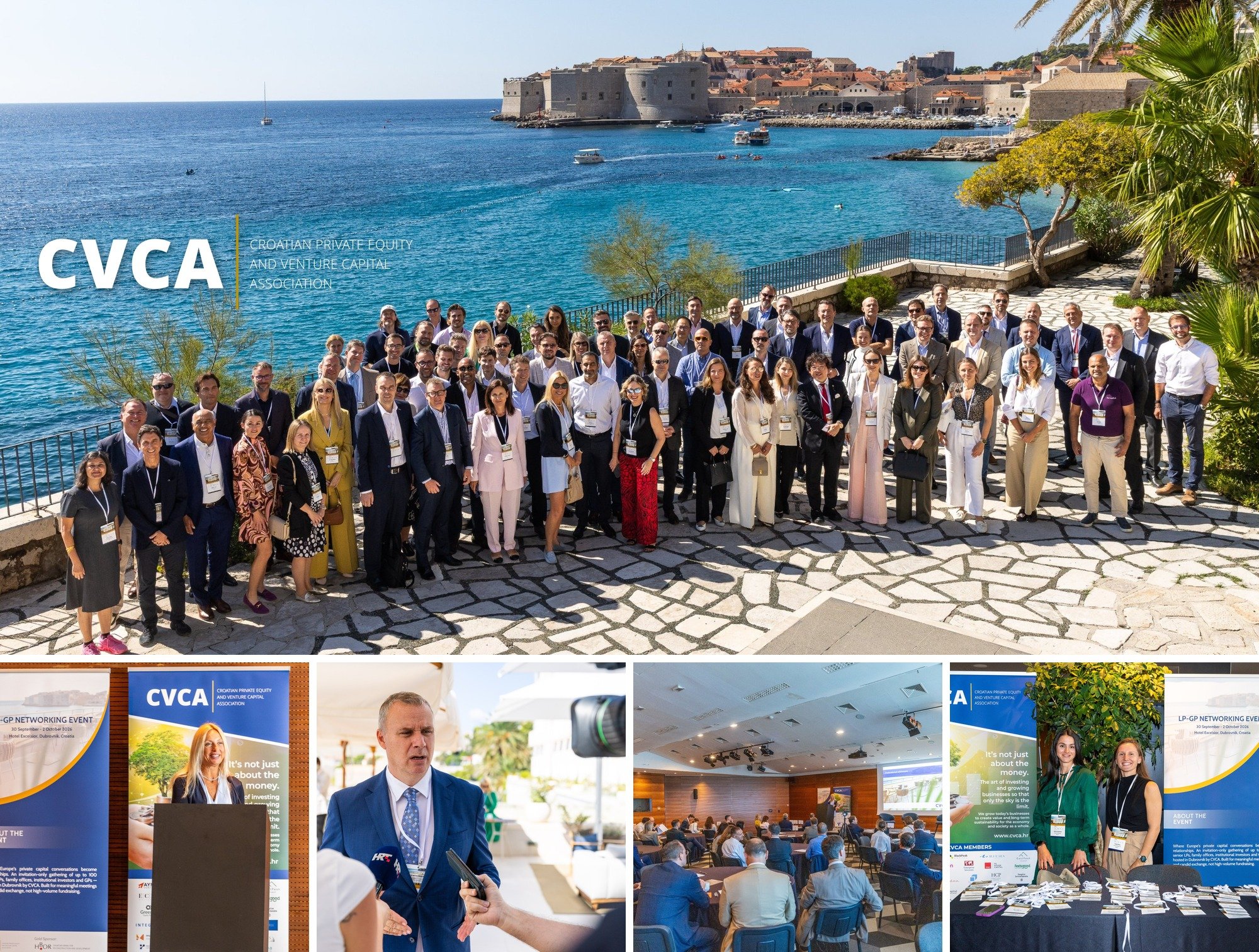
Dubrovnik, 7 October 2026 – The LP-GP Networking Event 2026, held from 30 September to 2 October at Hotel Excelsior in Dubrovnik, brought together 90 senior representatives of leading private equity and venture capital investors and fund managers for the fourth edition of one of Europe’s most carefully curated gatherings of Limited Partners (LPs) and General Partners (GPs). Organised by the Croatian Private Equity and Venture Capital Association (CVCA), the invitation-only event was capped at 100 participants by design, and the 90 who gathered in Dubrovnik were selected in a one-to-one ratio of LPs to GPs: pension funds, insurers, development finance institutions, funds of funds, private banks, asset managers and single family offices on one side; private equity, venture capital, growth, mezzanine and private debt fund managers on the other – every one of them a senior decision-maker. After two editions in Dubrovnik and one in Zagreb, the event returned to Dubrovnik with participants from across Europe as well as from the United States, Japan and India.
The event is hosted by CVCA, which its President Mirna Marovic founded 21 years ago. Today CVCA is one of the largest national private equity and venture capital associations in Central and Eastern Europe, with 28 regular members – fund managers of alternative investment funds that together manage more than EUR 4.5 billion – and 11 associate members, the LPs and advisers that make the ecosystem work. Many of them were among the participants in Dubrovnik.
In her welcome remarks, Mirna Marovic, President of CVCA and chair of the LP-GP Networking Event, set out the philosophy behind the format: “Every one of them was invited, and every one of them decides – capital, mandates, funds, portfolios. There are no crowded halls and no badge scanners. There is no fundraising by ambush. We capped this event on purpose, because the conversations that move a fund forward do not happen in a queue of two thousand people; they happen at a table for six, on a terrace, with the Adriatic in front of you.” Addressing the international investors in the audience, she added: “If you are looking for a way into this region, you are sitting next to it.”
Institutional addresses: HBOR, EIF, IFC and HANFA
The conference opened with addresses from four institutions that have done more than any other to build Croatia’s private capital market. The Croatian Bank for Reconstruction and Development (HBOR), the event’s Gold Sponsor, has together with the European Investment Fund built the domestic fund industry, committing around EUR 130 million to 11 funds that have financed more than 230 Croatian companies. Hrvoje Cuvalo, President of the Management Board of HBOR, said: “Croatia’s capital market has made significant progress in recent years, and today more sources of financing are available than ever before. Our goal is to identify the areas where market gaps still exist and to develop instruments that will attract additional private and institutional capital. We believe that it is precisely the partnership between the public and private sectors that can deliver the greatest development impact for the Croatian economy.”
John McIlwaine, Senior Regional Representative for Italy, Malta and Croatia at the European Investment Fund (EIF), who also led the institutional LPs-only breakfast and joined the afternoon LP panel, said: “Impeccably organised event, in a truly inspiring setting. Perfect mix of LPs and GPs, social impact investors to VC ‘royalty’, regulators with a vision and thought leaders, national and supranational institutions. I am excited to see such a powerful, and growing, private equity and venture capital ecosystem, backed by strong and committed local institutional investors, regulators, and national promotional institutions. In Dubrovnik were had in the same room investors willing to commit and fund managers worth committing to. We heard about the importance of cornerstones like EIF and the power of the first cheque. Looking forward to EIF continuing to play that role in Croatia. Ajmo!”
From a global development perspective, the International Finance Corporation (IFC) reaffirmed its long-term commitment. “The International Finance Corporation (IFC), the private sector arm of the World Bank Group, has been investing in emerging market private equity and venture capital since the 1980s. As the largest investor in emerging market funds globally, we know that patient capital builds companies, creates jobs, and grows ecosystems,” said Magdalena Soljakova, IFC Senior Country Officer for Croatia and Slovenia. “When markets get harder, that is precisely when a long-term investor like IFC matters most.”
Anamarija Stanicic, Deputy President of the Board of the Croatian Financial Services Supervisory Agency (HANFA), addressed Croatia’s competitiveness and the measures a small market can take to become more attractive to venture capital, private equity and institutional investors, presenting the RoadToMarket sandbox, the SPOT market for unlisted shares and HANFA’s initiatives to strengthen Croatia’s regulatory competitiveness. She highlighted: “If we want a stronger private capital market in Croatia, it is not enough merely to ensure the availability of capital. It is equally important to increase the number of companies that are ready to attract capital, develop attractive exit opportunities for investors, and build a regulatory framework that is competitive, proportionate, and focused on supporting economic growth. As a regulator, Hanfa cannot create successful entrepreneurs, make investment decisions, or generate returns. However, by implementing strategically targeted initiatives, it can help create a market in which high-quality companies, capital and investors can connect more easily.”
Keynotes: AI, venture through the cycle, climate tech, LP conviction, data and the power of the story
The keynote programme was built around eight questions that will define 2026: turning headwinds into tailwinds; distributions and liquidity; whether Europe can win the technology race; the AI application layer; LP-GP alignment; manager selection; emerging managers; and value creation and exits. Tim Gordon, Partner at Best Practice AI, opened with “How Europe can prosper in the Age of AI”: “The rapid growth of the AI industry puts Europe at a crossroads. We can choose to embrace the technology, mindful of the risks and issues involved, or we can hold back and let the US and China build an unassailable lead. Croatia and its neighbours bring real strengths to the table and the conference was a superb opportunity to explore how investment can unlock them.”
DN Capital, founded in 2000 and one of Europe’s longest-standing venture capital firms, with investments including Shazam, Auto1 and Remitly, brought three decades of cycles to the stage. Steven Schlenker, Founder and Managing Partner, delivered the keynote “Venture through the cycle: AI, liquidity and building enduring European technology leaders”, on generating liquidity across technology and IPO cycles as a European investor, followed by a fireside chat with his co-founder Nenad Marovac, Founder and Managing Partner of DN Capital, moderated by Mirna Marovic. Four further keynotes followed: Danijel Višević, General Partner and Co-Founder of World Fund, on climate tech as a European resilience strategy, from innovation to global scale; Dariusz Pietrzak, Partner at Enterprise Investors, on earning LP conviction in 2026 through value creation, exits and alignment in European private equity; Marija Djordjevic, Head of Alternatives Research, Aladdin Client Business, at BlackRock, on what the data reveals about performance, risk and liquidity in private markets in 2026; and Tilo Bonow, Founder and CEO of Piabo and of the single family office Bonow Ventures, on why the best story wins and communications as a value-creation lever for GPs and their portfolios.
Emerging managers and the evidence behind them
A hallmark of the event is its dedicated session for emerging fund managers, this year presented by the Bronze Sponsors: Florian Loebermann, Partner at GET Fund, a European climate-tech growth investor (“Triple top line: when impact drives growth”); Domagoj Oreb and Pierre Matek, Managing Partners of Feelsgood Capital Partners, the impact venture capital firm currently closing its second fund (“From Feelsgood to Feelsbetter: proving social impact pays”); Dragos Petre, Partner and CFO, and Dragalina Dragan, Investor Relations, ESG and Investment Manager at Morphosis Capital, a top-quartile private equity firm focused on the lower mid-market (“DPI is the new IRR”).
In her keynote “Has persistence persisted in private equity? Evidence from buyout and venture capital funds, and why emerging fund managers deserve a chance”, Mirna Marovic presented the findings of Harris, Jenkinson, Kaplan and Stucke (Journal of Corporate Finance, 2023), based on the cash flows of 2,337 US buyout and venture funds, alongside PitchBook’s global analysis. Using only the information an LP could actually see at the time of fundraising, a top-quartile predecessor in buyout gave the next fund a 24 per cent chance of finishing in the top quartile – against 25 per cent by random chance – while first-time buyout funds landed in the top quartile 30 per cent of the time; in venture capital, persistence does persist, and first-time venture funds raised after 2000 delivered the highest market-adjusted multiple in the sample. “Has persistence persisted in private equity? In venture – yes. In buyout, what persisted was the habit of looking for it,” said Marovic. “A track record opens the conversation. It should not close it. The next top-quartile GP is raising Fund I today, and is quite possibly in this hotel.” She reminded LPs that emerging managers raised only 12.7 per cent of the capital in 2023, the lowest share since before 2000, quoting the authors’ own conclusion that “investors who insist on a prior track record before investing in a new GP have therefore historically missed out on above average performance”.
Inside the minds of LPs
In line with its core mission, the event devoted the afternoon to the investors who write the cheques. The fireside chat “Inside the single family office: how private wealth selects and backs private capital fund managers” brought together Alexander Vaselek, CEO of CIMEDO; Christoph Roos, Strategic Advisor and Investor at Finkeissen Holdings; and Milan Cvetkovic, Chief Investment Officer and Head of Private Equity at Paula Invest AG – three single family offices – moderated by Tilo Bonow. The LP panel “Inside the minds of LPs: what drives allocation in 2026 and beyond”, moderated by Mirna Marovic, gathered Gordan Kuvek, Executive Director of the Strategy Division at HBOR; Gordana Neralic, Chief Investment Officer of Erste Ltd., pension funds management company; John McIlwaine of the EIF; Uros Acko, CEO of SID Upravljanje Premozenja; Cyrille Flichy, Head of Private Markets at BCGE, the Banque Cantonale de Geneve; and Tobias Winter, Senior Portfolio Manager Private Equity at UNIQA. Against the backdrop of a fifth consecutive annual decline in private capital fundraising, record-low distributions relative to net asset value and capital concentrating in the largest funds, the panellists discussed what actually moves their money: the role of DPI and liquidity in allocation decisions, the balance between established and emerging managers, and what wins a GP the second meeting.
The conference dinner at Restaurant Dubrovnik featured a dinner keynote by Tariq Fancy, Lecturer at Stanford Graduate School of Business and Founder of Treebeard Funds, on green financing, asset repricing and capital structures in sustainable infrastructure: “Every financing boom ends in a reset, and when the market turns and rates rise, the marks are the last to know. Green finance is where I see it most clearly: the assets are fine, but the capital structures built at zero rates are not. The next chapter belongs to investors who look past the reported number to the cash, and who are willing to be the second money, not the first.”
Side events: where the conversations happen
The one-day conference was deliberately balanced with side events designed for relationship-building rather than high-volume fundraising. The event opened on 30 September with a welcome drinks reception on the terrace of Hotel Excelsior and a networking dinner at Banje Beach. The conference day began with two invitation-only breakfasts held under the Chatham House Rule, each gathering around 20 LPs: a family-office-only breakfast on global asset allocation and private-capital investing, with a keynote and moderation by Ignacio Garcia of Trampoline Venture Partners, a single family office, and an institutional LPs-only breakfast on peer exchange and best practice in private-capital investing, including due-diligence procedures and reporting, led by John McIlwaine of the EIF. Throughout the event, CapitalCircle, the private participant app, allowed LPs and GPs to browse the full attendee list and pre-arrange one-to-one meetings, which continued on the terrace between sessions and over the conference dinner. The programme closed on 2 October with an excursion to Konavle – a guided nature walk, an introduction to Croatian customs and heritage, networking drinks and a traditional lunch – before participants were transferred to the airport.
Closing the conference, Marovic summed up the fourth edition: “This was the fourth edition, and it was the best one yet – and I am already, against the advice of my team, thinking about the fifth.”
About the organiser
The LP-GP Networking Event 2026 was organised by the Croatian Private Equity and Venture Capital Association (CVCA), the national voice of private capital in Croatia, with VentureXchange / VX Associates as organising partner. CVCA represents private equity and venture capital fund managers and investors active in Croatia and across Europe, engages with policymakers and promotes responsible investment as a driver of innovation, growth and competitiveness.
CVCA extends its sincere thanks to the Gold Sponsor, the Croatian Bank for Reconstruction and Development (HBOR), and to the Bronze Sponsors – Collateral Good, Feelsgood Capital Partners, GET Fund and Morphosis Capital – for backing an event whose whole premise is that quality matters more than volume.
For more information about the LP-GP Networking Event 2026 programme, speakers and partners, please visit www.lp-gp-networking.com; for upcoming CVCA initiatives, www.cvca.hr.
Media contact: Mirna Marovic, President, CVCA – mirna.marovic@cvca.hr